Maharaja Ranjit Singh
Rise to Power
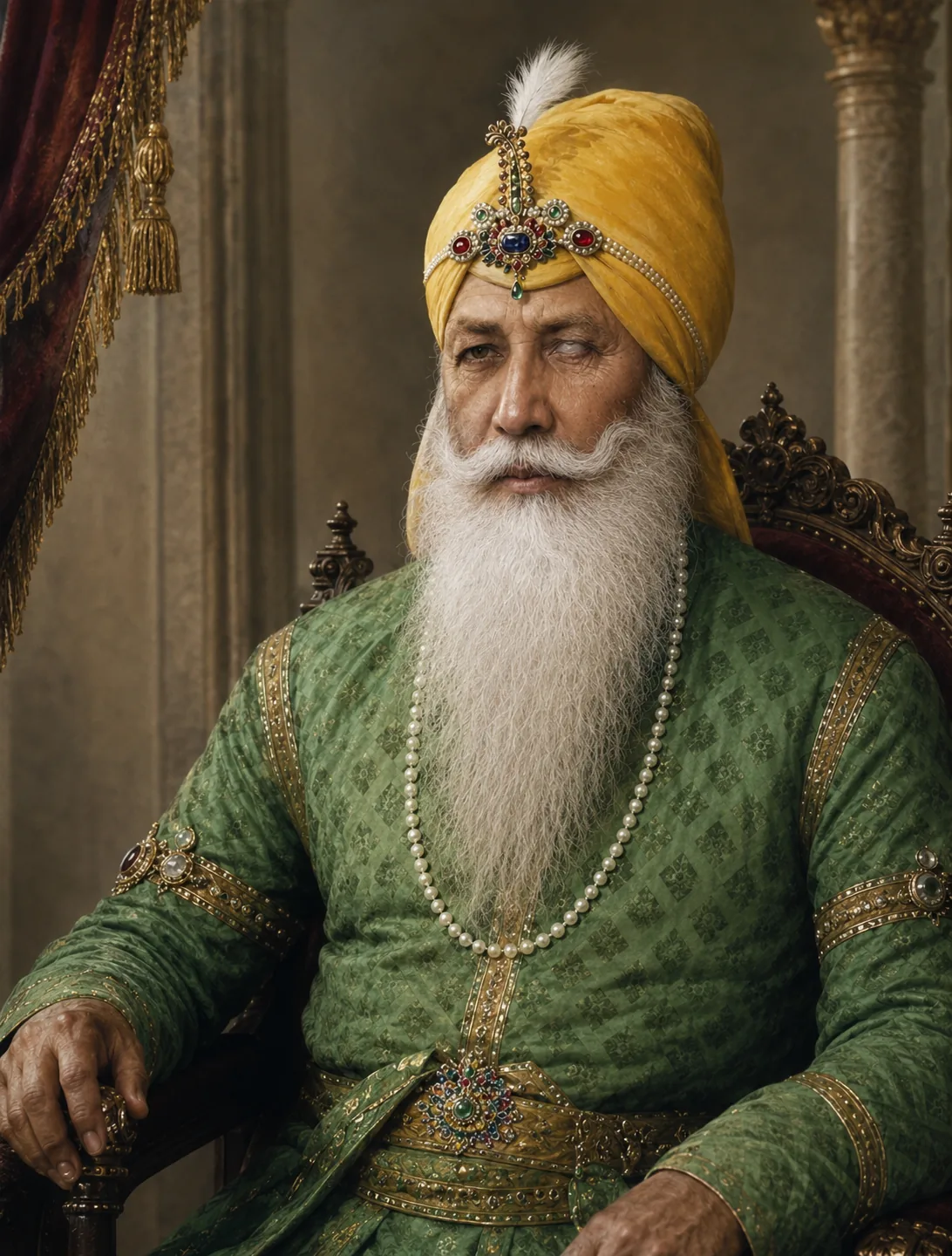
Born in 1780 in Gujranwala (now Pakistan), Ranjit Singh survived smallpox as a small child. It left him blind in his left eye and marked his face for life, and he never showed the slightest embarrassment about either. He is said to have remarked that God had intended him to look at all religions with one eye - the sort of line that attaches itself to famous men, but one that matched how he actually governed.
His father, Maha Singh, died in 1792, leaving him head of the Sukerchakia misl at about twelve. He was never taught to read. For the whole of his life, treaties, dispatches and accounts had to be read aloud to him, and he ran one of the most sophisticated states in Asia by memory, judgement, and an extraordinary instinct for other people.
The Punjab he inherited was not a country but a patchwork. Twelve Sikh misls held different territories and fought each other as readily as they fought outsiders, while Afghan invasions came down through the passes almost as a season of the year. In July 1799, aged eighteen, Ranjit Singh took Lahore from the Bhangi misl - backed by his formidable mother-in-law Sada Kaur, whose Kanhaiya forces and political nerve made the whole thing possible and who is too often left out of the telling.
On Vaisakhi in 1801 he was formally proclaimed Maharaja of Punjab. The detail worth keeping is what he did next: he struck his coinage not in his own name but in the name of the Gurus, and called his government the Sarkar-e-Khalsa - the government of the Khalsa. He never sat on a throne in the European sense, never put his own face on a coin, and described himself as a servant of the Panth. For an absolute ruler, it was a striking piece of restraint, and it told his Sikh subjects exactly whose authority he claimed to be borrowing.
Building the Empire
Amritsar fell to him in 1802, giving him the spiritual heart of the Sikh world as well as its richest trading city. What followed was forty years of steady, patient expansion, most of it northward and westward into country no Indian power had held for centuries.
- 1809 - the Treaty of Amritsar. Facing the expanding East India Company, Ranjit Singh signed a treaty with the British that fixed the Sutlej as the boundary between them. It closed off his ambitions to the east for good, and it bought his empire thirty years of life. He never fought the British; he simply outlived the possibility.
- 1818 - Multan. The great fortress city of the south fell after a long siege, ending Afghan authority in the region.
- 1819 - Kashmir. Wrested from the Durranis and brought under Lahore's administration.
- 1823 - Nowshera. A hard-fought victory over Afghan forces west of the Indus, in which Akali Phula Singh was killed leading a Nihang charge. Peshawar was formally annexed in 1834.
- 1834 onwards - Ladakh and Baltistan. Taken by Zorawar Singh, campaigning for the Dogra ruler of Jammu who held Jammu as Ranjit Singh's feudatory, pushing the empire's reach to the edge of Tibet.
By the 1830s he governed a state running from the Khyber Pass to the Sutlej and from Kashmir down towards Sindh - the last major independent power on the subcontinent, and the only one the British never defeated in his lifetime.
The Khalsa Fauj
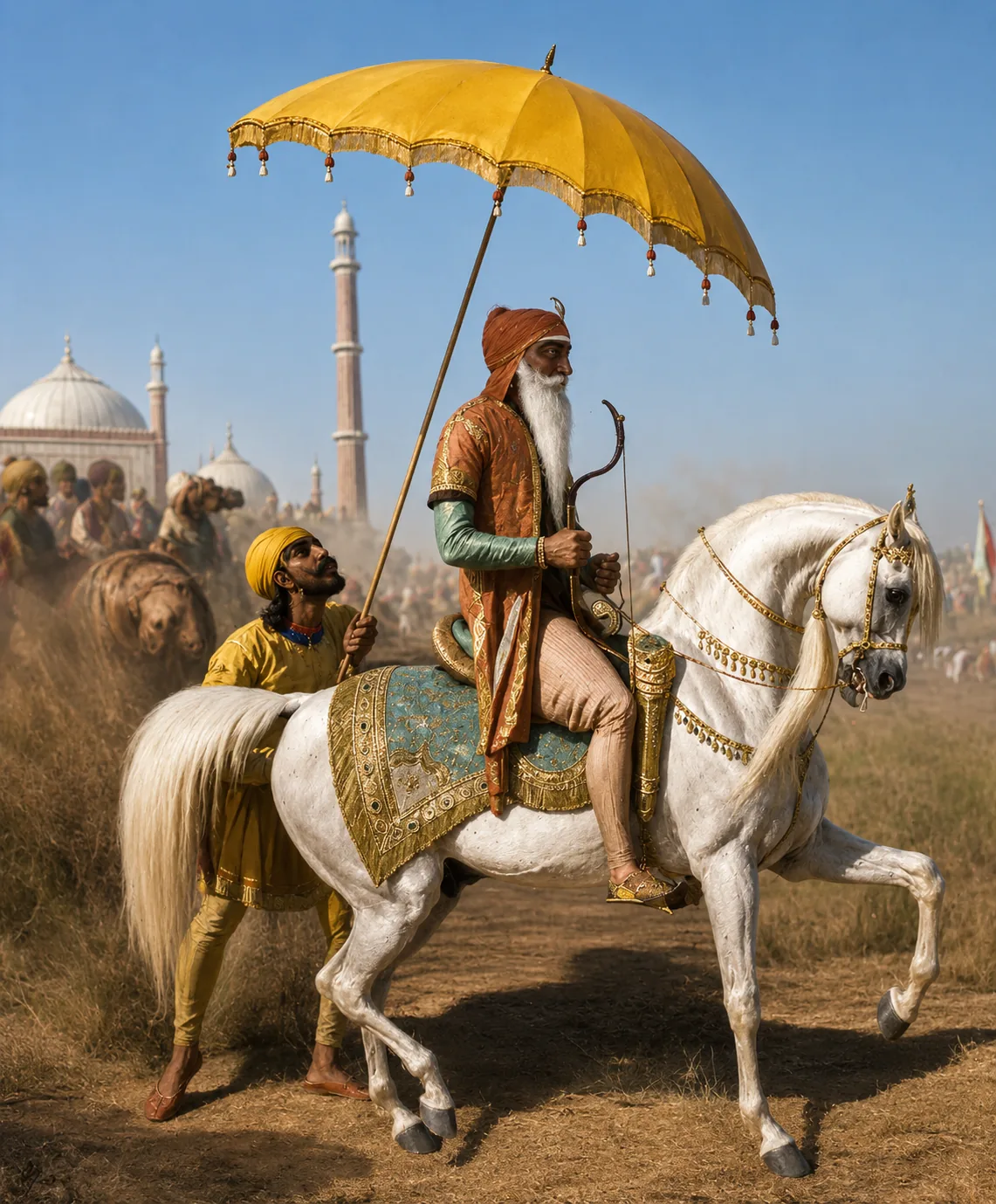
The army was the achievement that made the rest possible. Ranjit Singh understood early that the misls' traditional cavalry, brilliant as it was at raiding, could not stand against disciplined infantry and modern guns. So he built something new.
He recruited European officers - many of them veterans of Napoleon's armies with nowhere left to fight - and gave them real authority. Jean-François Allard and Jean-Baptiste Ventura drilled his infantry and cavalry into the Fauj-i-Khas, the elite corps; Claude Auguste Court and Alexander Gardner built his artillery and foundries; Paolo Avitabile governed Peshawar with a severity still remembered there. They were paid extremely well, expected to adopt local dress and custom, and forbidden to eat beef or smoke. Alongside them rose Punjabi commanders of the first rank, above all Hari Singh Nalwa, whose name is still invoked on the North-West Frontier.
The result was an army of perhaps 80,000 trained men with its own cannon foundries - by common consent the most formidable force in Asia outside the Company's, and the reason the Anglo-Sikh Wars that came after his death were fought so close.
How He Governed
What makes Ranjit Singh unusual is not that he conquered a great deal of territory. Plenty of men did that. It is how he held it: a Sikh sovereign ruling a population that was majority Muslim, with a large Hindu minority, for forty years, without the religious violence that marked almost every comparable state of the period.
- A court of all faiths. His foreign minister, Fakir Azizuddin, was a Muslim and one of his closest confidants. Dewan Dina Nath ran his finances and was Hindu. Muslims, Hindus, Sikhs and Europeans held senior command and civil office, and appointment ran on usefulness rather than creed.
- No capital punishment. In an age when execution was the ordinary answer to rebellion, Ranjit Singh abolished the death penalty and is not recorded as having ordered a political execution in forty years of rule. Defeated enemies were commonly pensioned rather than killed - which was, among other things, extremely good politics.
- Endowments across the board. He funded gurdwaras, but also Hindu temples and Muslim shrines and mosques, and confirmed existing grants rather than stripping them. He commissioned the gold and marble work on the Harmandir Sahib that gave the world the name "Golden Temple".
- Persian at the desk, Punjabi in the room. He kept Persian as the language of administration, inherited from Mughal practice, while the business of his court was conducted in Punjabi - a practical man's answer to running a state with several literate traditions in it.
The Man Himself
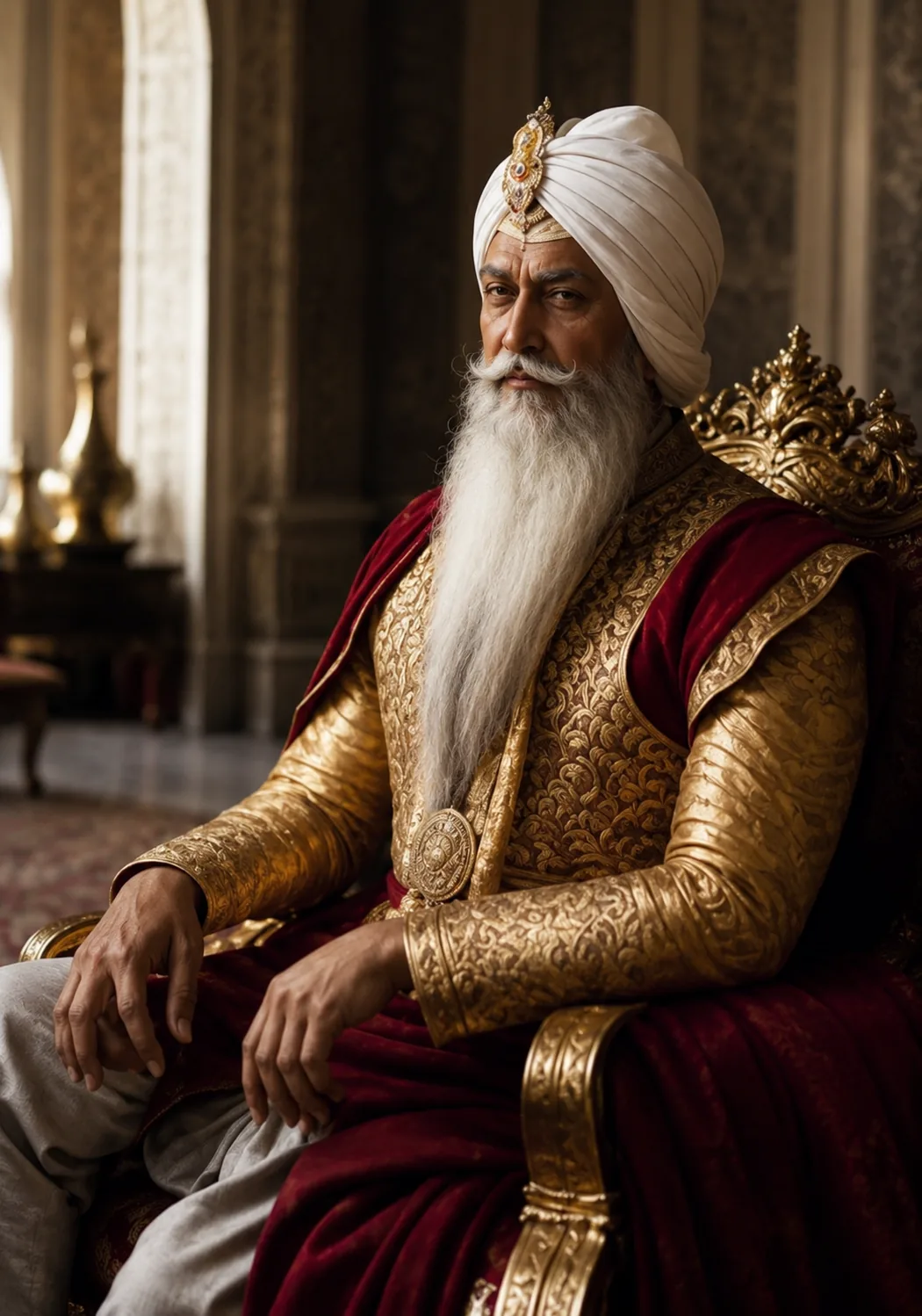
Contemporaries who met him left a consistent picture: a small, spare, one-eyed man, pockmarked, plainly dressed among courtiers dripping with jewels, who asked relentless questions and remembered every answer. European visitors expecting an oriental despot tended to come away unsettled by how closely they had been examined.
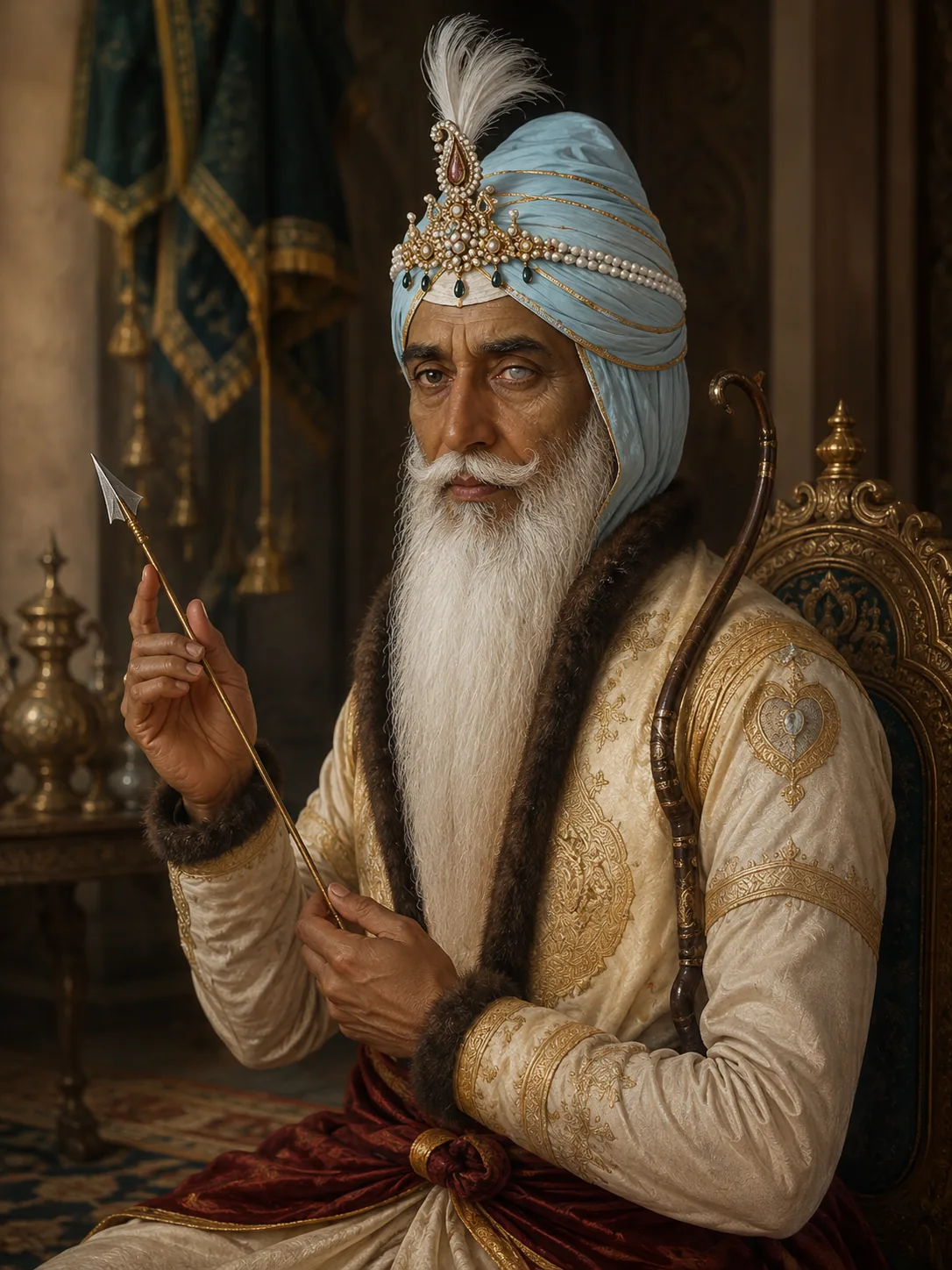
The episode most often told about him concerns Akali Phula Singh, the Nihang commander who was also jathedar of the Akal Takht. Summoned to Amritsar to answer for his conduct - the usual account involves his relationship with Moran, a Muslim dancing girl - the Maharaja came, accepted that he was subject to the authority of the Panth, and presented himself for punishment. He was sentenced to be flogged, and the sentence was remitted only when he had submitted to it. The details vary between tellings and the story has plainly been polished by repetition. What has kept it alive is the part nobody disputes: the most powerful man in northern India accepted that something stood above him, and did it in public.
The Harder Parts
A page that only praised him would not be much use. His reign has real shadows, and they belong in any honest account.
When he died, four of his queens and several women of his household were burned on his funeral pyre. Sati was practised at his court and he did not end it, though he had ended much else. Under Sikh rule the Badshahi Mosque in Lahore was used for a time as an ammunition store and its precincts as stables - a humiliation Lahori Muslims remembered long afterwards, and one that sits awkwardly beside his record of endowments. Cow slaughter was banned, which pleased his Sikh and Hindu subjects and did not please everyone else. His revenue demands on the peasantry were heavy, as they were everywhere, and the tolerance of his court did not amount to anything a modern reader would call equality.
None of this cancels the achievement. It does mean the achievement was a ruler's, made under a ruler's constraints, rather than a saint's.
What Came After
He suffered a series of strokes in his last years and died at Lahore on 27 June 1839. His samadhi still stands there, beside the Badshahi Mosque and within sight of the fort he took at eighteen.
What followed is one of the fastest collapses in the subcontinent's history, and it is worth setting out plainly, because it is the answer to why an empire that strong lasted ten years past its founder:
- 1839 - Kharak Singh, his eldest son, succeeds and is quickly sidelined; he dies in 1840.
- 1840 - Nau Nihal Singh, his grandson, is killed by falling masonry on the day of his father's cremation.
- 1841-43 - Sher Singh rules briefly and is assassinated, along with much of the court, in a spiral of factional murder involving the Dogra ministers and the army's own panchayats.
- 1843 - The five-year-old Duleep Singh is placed on the throne, with his mother Jind Kaur as regent - the last figure of the dynasty to fight for it seriously.
- 1845-49 - Two Anglo-Sikh Wars. The Khalsa army fights the Company to a standstill at Ferozeshah and Chillianwala and is beaten at Sobraon and Gujrat, partly by generals of its own who had already decided how the war should end.
- 1849 - Punjab is annexed. Duleep Singh is exiled to England; the Koh-i-Noor goes with the Crown.
Legacy
Ranjit Singh's empire did not outlast him by a decade, which has led some historians to argue that he built a state around a personality rather than institutions - that he never created the machinery to survive himself. It is a fair criticism. It is also worth setting against what he actually faced: a fragmented country, Afghan invasion as a recurring fact of life, and the most successful colonial enterprise in history advancing from the south-east.
What he left is the memory of a sovereign Punjab - multi-faith, prosperous, militarily formidable, and governed from Lahore by a Punjabi - which is why he matters so far beyond military history. For Sikhs he is the high-water mark of temporal power. For Punjabis of every faith, on both sides of a border he never saw drawn, he is the last ruler of an undivided Punjab, and the last time the region was the centre of its own story rather than a province of someone else's.
In 2020, readers of BBC World Histories Magazine voted him the greatest leader of all time, ahead of figures far better known outside South Asia. Such polls prove very little on their own. This one is worth noting mainly for what it says about how strongly he is still held - by a diaspora that has carried his memory to Britain, Canada, and everywhere else Punjabis have gone.